What Skeletons Taught Me About Living

Updated: Aug 5
Death is not the enemy of life, but its measure of a life well-lived.
I learned to fear death long before I ever understood life. I grew up singing hymns which boasted of life triumphing over death. We spoke of resurrection power and gloried in verses like, “O death, where is thy sting? O grave, where is thy victory?”
But underneath the words was always an undercurrent of dread. Death was not spoken of as a natural part of life, not it was the doorway to judgment, and every breath carried the weight of my eternal reward. The result was that death became something to both deny and fear.
Because if meaning only exists in some future life, then what happens if you never reach that reward? What if this life is just wasted breath, a meaningless prelude?
Instead of comforting me, that belief kept me paralyzed. I was ever haunted by the fear that I could never measure up, never live fully by Christ, never turn quickly enough to my spirit, never forsake what was natural in me, and never keep myself free from sin. Which meant my eternal reward was always at risk. Forever and ever, amen.
Leaving that system a strange thing happened. Letting go of those beliefs not only removed the fear, but death actually grew strangely comforting. It was somehow a relief to simply belong to nature’s process, to take my place in a cycle older and wiser than humanity itself. Somehow I found so much peace in that.
My fear now is no longer of death. No, now my fear is a life that is not well-lived.
I fear never daring to inhabit this single, short, and oh-so fragile life that is entirely mine.
There’s a lyric in a song by Switchfoot that I’ll never forget. Life is short; I wanna live it well / One life, one story to tell. And while Christian bands aren’t really on my playlist anymore, I have to give creds where they are due. And those words hit hard.
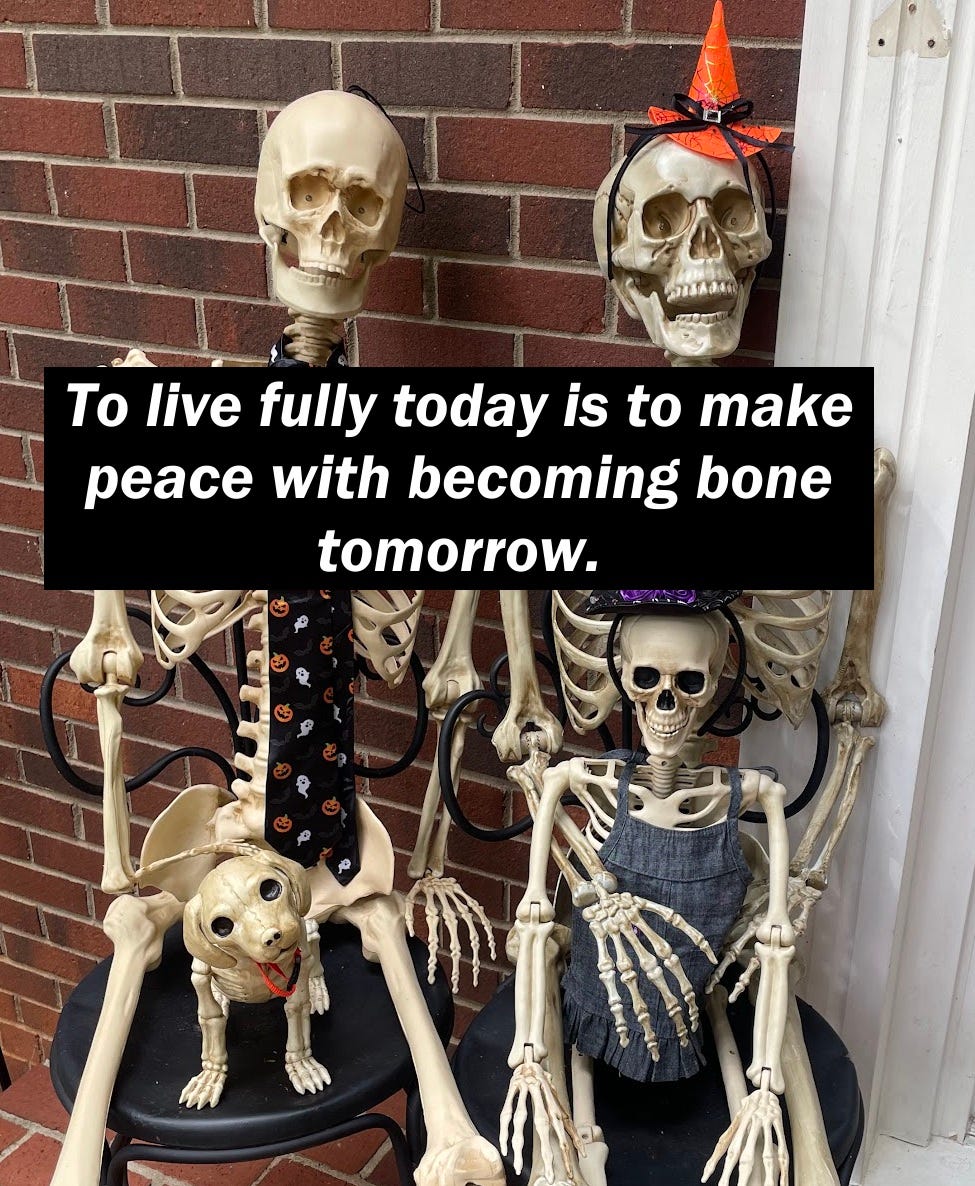
If you had told my former self, the girl who thought Halloween decor, that one day she’d have not one but four skeletons lounging on her porch. Well she would have gasped and prayed for her soul. (you’re on the highway to hell girlfriend!) Yet here we are.
Our skeletons stay out all October, and I smile every time I see them. They are no longer grotesque, not a symbol of terror. Ironically, our little skeleton family is a reminder of freedom—the freedom of no longer being terrorized by death itself. They grin at me every time I come home, a rictus of eternity, and in their hollow grin I hear them say, “You are here, you are alive, and that is enough.”
I believe, to the marrow of my being, that to live fully today requires making peace with becoming bone tomorrow.
I was reminded of this once while driving with my daughter. A deer had died at the side of the road, and vultures were gathered, doing what vultures do. She was disgusted. I was grateful. The cycle was working: nothing wasted, everything returning. Vultures, those much-maligned birds, are the earth’s garbage disposals. Without them, we would be overwhelmed with rot. They are part of the balance.
Death is part of the balance.
So much of the American culture recoils from death, I fear that may be part of why our care for the elderly is so tragic. When we treat death as something to exile and ignore, instead of a natural part of living, we risk pushing away those who remind us of death as well. And in pushing them away, we also push away the wisdom and beauty they offer.
This Halloween, when I see skeletons on porches, I’m reminded that living without fear of what comes after is its own freedom.
Death is not the enemy of life, but its measure. The real haunting was never death, but the risk of a life unlived.


Comments