That Time My Daughter’s Compassion Was Dismissed as Immaturity
- sarahstiltner
- Nov 17, 2025
- 4 min read

Updated: Mar 3
This is Part 2 in a Series entitled: Grief, Remorse, and the Slow Rebuilding of a Moral Compass. Read Part 1 here.
Some memories from my past-life come back gently. And there are others that arrive with a kind of quiet humiliation, a reminder of how far I once bent myself to fit inside a world that distrusted the simplest forms of goodness.
This is the story of one of those.

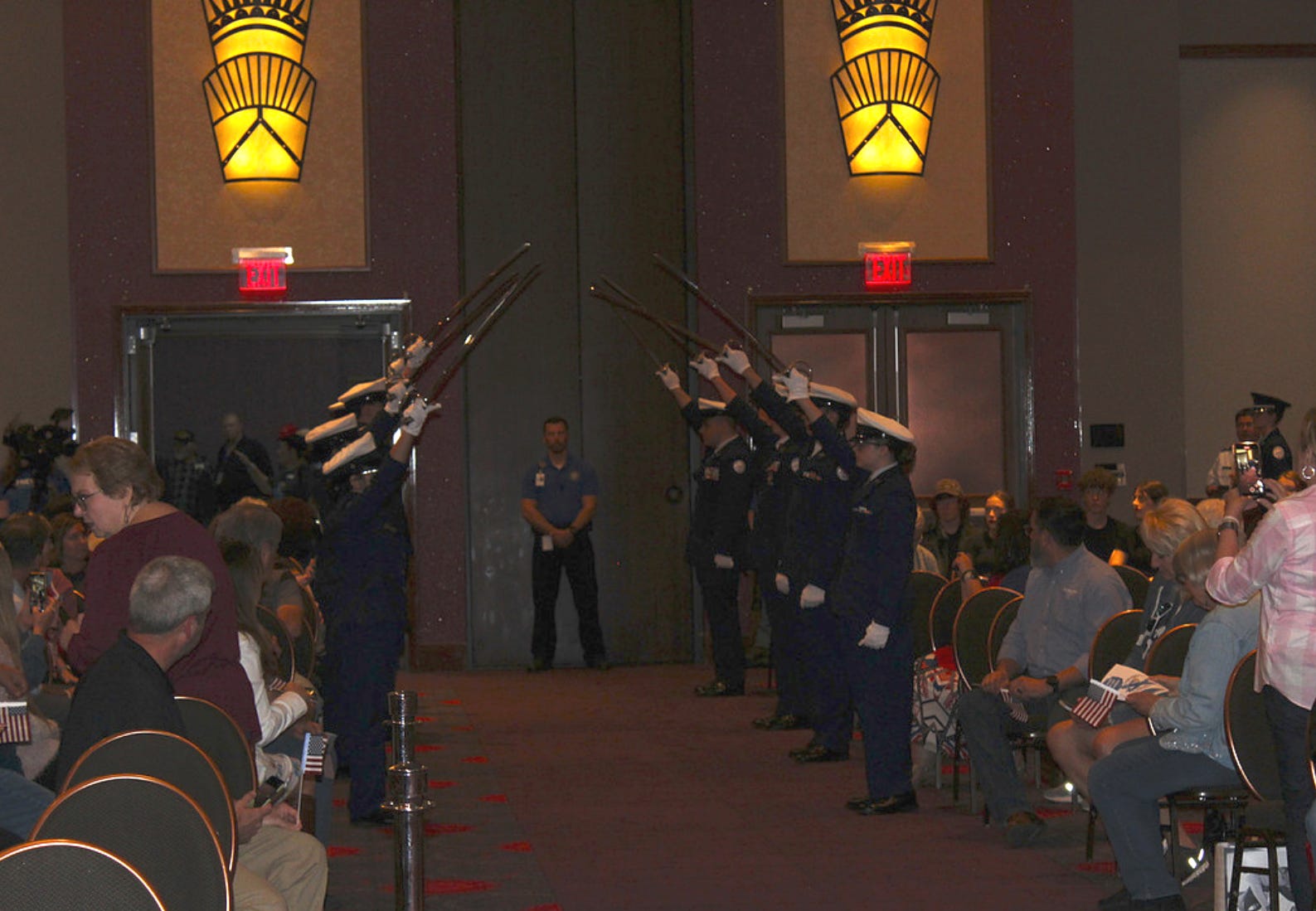
The story starts with Honor Flights. Honor Flights bring veterans to the nation’s capital to see the memorials that commemorate their service. These veterans are elderly, some in wheelchairs, some traveling with oxygen or other medical devices, but all are traveling with stories they have carried for years. The day begins with a banquet in the veterans’ honor, followed by a ceremony. At the end of the day, the entire airport fills with applause as they leave for Washington, D.C., a grand send-off meant to give them a small taste of the homecoming they should have received.
As soon as my daughter learned about the Honor Flights, she asked if she could volunteer. No one made her. She was still young, but she carried an instinct for people who were overlooked or hurting. She arrived that day with a kind of quiet certainty that came from her own strong sense of right and wrong. She sat with a gentleman who fought in Korea, served him a meal and pushed his wheelchair, but mostly she stood with him, bearing witness to the sacrifices he made for a country that has not always remembered him well.
She also jumped at the chance to volunteer at the traveling Vietnam memorial, the Wall That Heals. She spent hours helping visitors search for the names they came to find, to gain the closure they had been denied by time and space. She guided grieving children, aged siblings, childhood friends, and comrades in arms to the exact panel and line, then stood with them as they traced the engraved letters. She told me later that it felt like something sacred, watching strangers grieve, wrinkled fingers tracing names as if they were the familiar lines on a loved one’s face. She stood with them as they wept, bearing witness to their pain.
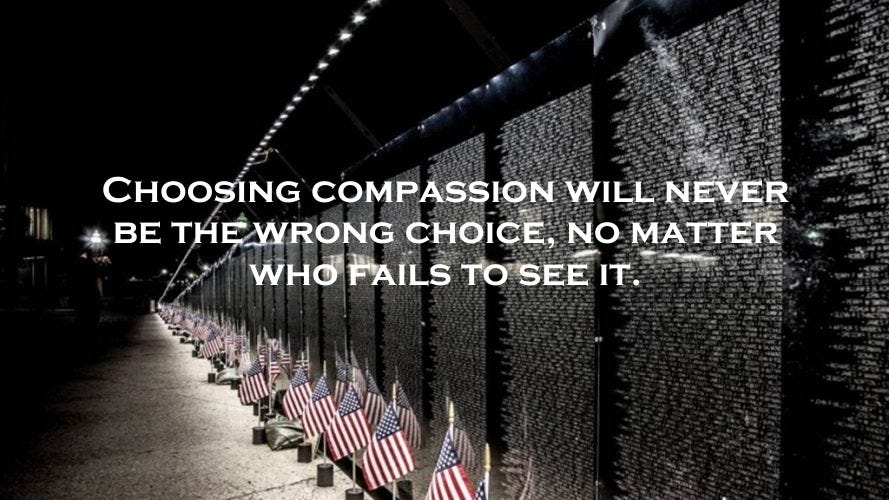
She chose this work because it mattered. (Because it DOES matter!) Because she believed, in the way young people sometimes do, that compassion is never wasted.
It was good work. It was human work. It was the kind of service that asks nothing in return. Yet inside the high-control Christian group in which we lived, it was treated as a problem.
You see, on those two occasions she was serving veterans, she was also missing the weekly young peoples meeting held every Saturday night.
Witness Lee’s teachings created a theological hierarchy that places “spiritual” labor over all forms of practical benevolence. The result is not an outright rejection of doing good, but a consistent de-prioritization of human needs unless they directly support “the ministry.” The result was that by her serving with veterans, we were now in trouble.
We were told it was tragic that she was missing young people’s meetings and ministry messages to do something that was “natural goodness” and not something “good for the building.” We were cautioned that we were risking her spiritual growth for something that would draw her away from her “high calling.” We were reprimanded for setting a bad example, and that our service must be vertical (to God / ministry), not horizontal (to people).
I remember feeling a strange confusion as I was being rebuked. I knew in my bones that my daughter was doing something meaningful, and yet here I was being told it was meaningless by someone who claimed to speak for God. It made no sense.
I kept turning the moment over in my mind, and what rose to the surface was painfully simple.
My daughter stepped into the kind of work we liked to imagine ourselves doing. She spent her weekends honoring men who had survived unspeakable things, while we sat in folding chairs listening to ministry messages about life and truth. She stood beside the hurting. We stood beside outlines. She entered real human stories. We hid inside doctrine. And within that upside-down framework, her compassion was dismissed as immaturity. Her compassion was called a distraction from God.
Shame on them.
Shame on me.
I see now what I could not name then. The system could not imagine that serving veterans, or grieving with strangers at a memorial wall, could be a form of holiness. It did not have the language for compassion that required nothing in return. It did not have the room for empathy that did not advance its own agenda.
What I feel now, revisiting that memory, is a complicated grief. Grief for my daughter, whose instinct for kindness was questioned. Grief for myself, for the years I spent absorbing a worldview that taught me to doubt the most human things about myself.
And grief for the version of me who accepted those rebukes and allowed something inside to become dormant, unable to argue, unable to name what felt wrong, unable to give her daughter the affirmation she deserved.
This is why I am writing these essays. To untangle what was once twisted. To return to the memories I avoided because they carried too much shame and too much sorrow. To tell the truth now that I should have given myself then.
There are more stories to tell. More moments when instinct collided with doctrine, when compassion was treated like a threat, when goodness was called a distraction.
For now, I am sitting with this one.
The memory of my daughter honoring the wounded and the fallen.
And the realization that her compassion was clearer than any doctrine I had ever been taught.


Comments